


Insurgency migration journey to Hydra server hosting
Key takeways

Insurgency migration journey to Hydra server hosting
Overview
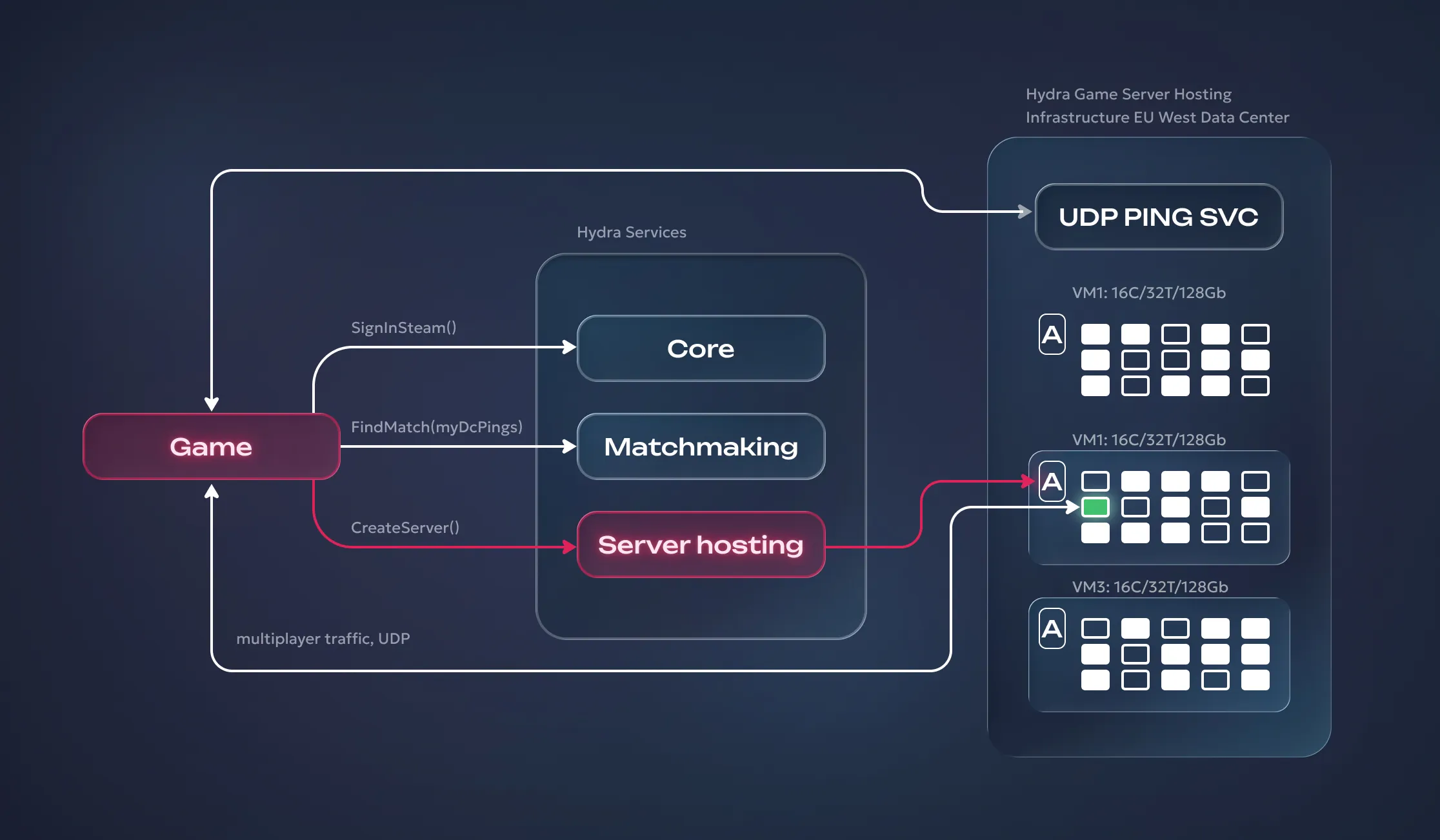
Before diving into the complexities of the migration, it helps to establish a clear baseline of how dedicated server infrastructure operates within the Hydra ecosystem.
The platform uses its own Dedicated Server Infrastructure to host Dedicated Servers for each project. A DS is a build of the game, compiled without graphical rendering and intended to run only the server-side logic. For each game session, a DS provides the multiplayer runtime: it maintains the shared game state, processes gameplay logic, and synchronizes connected players.
Typically, developers create a server build alongside their game client, integrating it with the Hydra SDK to unlock essential server-related functionality. Every time a game server (Dedicated Server) build is created, it is uploaded to the Developer Portal for configuration. Then, when players start a game and request a Dedicated Server of the appropriate version to host their multiplayer match, Hydra launches a Dedicated Server process on a physical server and passes initial game session parameters via command-line arguments. While players play the match, the Hydra infrastructure manages the Dedicated Server process - ensuring it remains in a healthy state, collecting diagnostics, and tracking CPU and memory consumption.
Across the global multiplayer gaming sector, corporate acquisitions of infrastructure providers often prompt studios to re-evaluate their long-term backend strategies.
When Insurgency’s hosting partner, Multiplay, announced its acquisition, the engineering team behind the project proactively decided to transition to Hydra. Their goal was to secure their infrastructure’s future, ensure long-term stability, and maintain absolute control over their operations.
The decision to transition to Hydra was driven by our proven track record across internal Saber Interactive titles and external partners. Beyond standard bare-metal hosting, we provide hands-on integration support throughout the entire game lifecycle: from early development to live operations. By continuously tracking real-time server performance and telemetry, Hydra guarantees stability and cost-efficiency under heavy player concurrency, making it the definitive choice for the team to future-proof their game.
Concurrently, the studio wanted to modernize its deployment pipeline and shed internal technical debt. By migrating their server hosting to our platform, we helped them achieve a seamless, zero-downtime transition. This strategic move allowed the studio to insulate itself from external corporate shifts, establish fully automated CI/CD pipelines, and cut its monthly server hosting costs by over 50%.
The Problem: Vendor Instability and Legacy Overhead
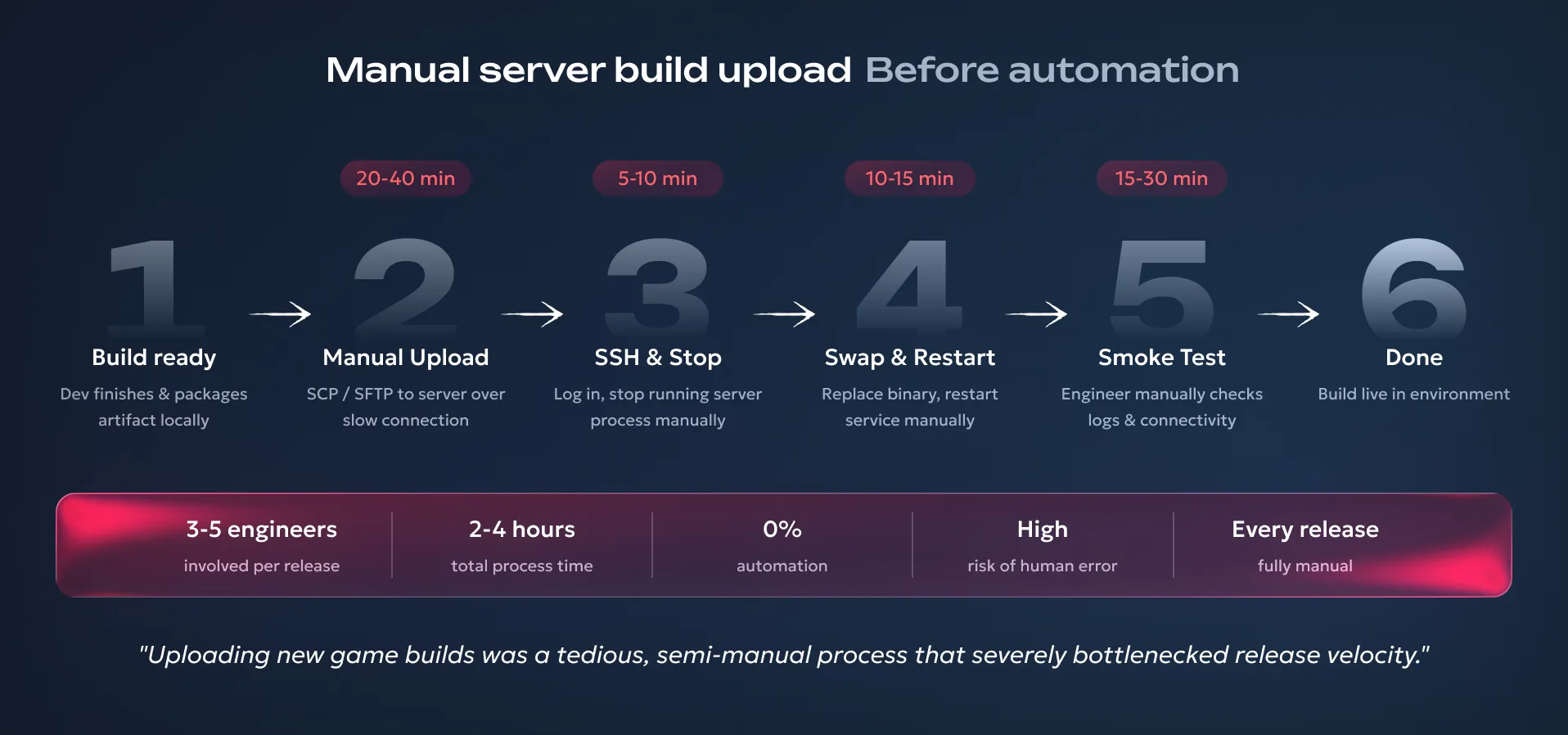
Following Multiplay’s recent acquisition, NWI recognized the strategic need to migrate to an independent platform where they could guarantee continuity and dictate their own technical direction. The team’s infrastructure relied on deprecated legacy systems. Uploading new game builds was a tedious, semi-manual process that severely bottlenecked their release velocity and consumed valuable engineering resources.
The Solution: Consolidating and Automating on Hydra
Moving to Hydra provided the stability and control the team needed to overhaul their deployment pipeline and simplify their backend. We worked with them to replace their manual upload process with a fully automated CI/CD pipeline. Our platform allowed them to establish two completely independent environments for Staging and Production that operate simultaneously.
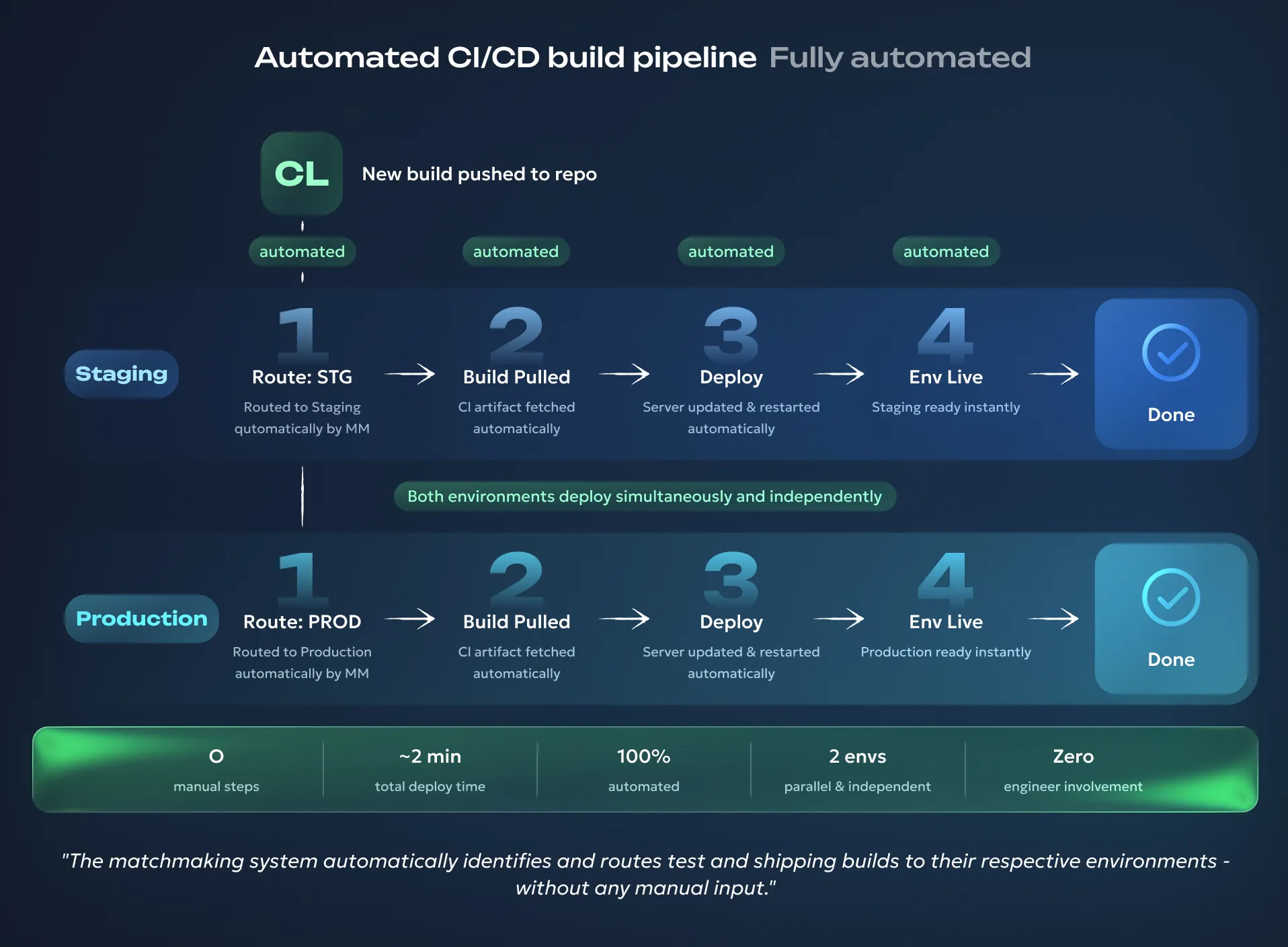
To take full advantage of this, the Insurgency team updated their matchmaking system to automatically identify and route test builds and shipping builds to their respective environments on Hydra without any manual input.
"The biggest convenience was in deployment. We were able to finally abandon manual upload. Today, everything happens completely automatically through our Jenkins pipelines, instantly pushing dedicated server builds to both our Staging and Production environments.It all became much easier and quicker to operate."

 Volodymir Tsiuriupa Tech Lead, Insurgency
 The Strategy: A Seamless, Parallel Cutover
To mitigate the risks associated with transitioning away from their legacy provider, the cutover to Hydra was engineered for absolute safety. Rather than relying on rigid server cut-offs, the core of this migration was a parallel integration strategy.
The Insurgency matchmaker was configured to support both Hydra and Multiplay simultaneously. This split-routing capability allowed the team to dynamically bleed live player traffic over to our servers while keeping Multiplay active as a seamless fallback. By running both infrastructures concurrently, the team achieved a true zero-downtime transition that was entirely invisible to the player base.
"We were living on both Multiplay and Hydra simultaneously, simply letting the traffic gradually transition over. Because our matchmaking system supported both environments at the same time, we could shift the player base seamlessly without needing to take any downtime for testing."
Mykhailo Moroz Developer, Insurgency Lessons Learned: Overcoming Integration Hurdles
Every major infrastructure shift uncovers edge cases, and integrating a complex live-ops title is no exception. One of the most concrete technical hurdles involved Unreal Engine’s networking capabilities. Initially, the Insurgency team struggled with dynamically specifying UDP ports during server allocation due to the engine’s and Hydra’s inherent limitations.
We delivered a fix to the Hydra server system to bypass this bottleneck by using the exclusive-udp-ports parameter in server configuration, which binds a specific port that the engine uses.
Aside from networking, we also tackled pipeline quirks, such as an early integration bug that erroneously flagged perfectly healthy server builds as containing errors, requiring immediate troubleshooting.
To unblock Insurgency deployments, our platform team quickly adjusted the backend parameters and delivered a fix. This allowed Insurgency engineers to accurately distinguish between healthy and unhealthy builds by directly using Hydra dedicated server logs. Our hands-on approach paid off, allowing the project team to move the migration more quickly.
Results: Architectural Simplification and Cost Efficiency
Pushing through those initial friction points resulted in a vastly modernized backend. By shedding the legacy architectural overhead and optimizing their resource allocation on our infrastructure, the studio successfully achieved a 50% reduction in overall server hosting costs.
The workflow improvements were equally massive; automating their pipeline reduced their build deployment times from two hours to under fifteen minutes.
Insurgency has been fully transferred to Hydra. Today, the operations team benefits from a cleaner architecture, long-term platform stability, and smooth daily deployments.
